call me ignorant but i genuinely don’t understand why sports have to be split up by gender.
@ everyone in the notes talking about physical performance: if that were the case, then sports would be divided by physical performance. that’s a thing you can measure. that’s a thing that varies by individual. a weak man and a strong man would be an unfair fight in boxing/wrestling/MMA, which is why they divide those sports up into weight groups based on physical performance. but they also further segregate them based on gender. chess is segregated by gender for no reason but sexism. if it’s actually about skill and physical ability, then measure those and separate people by those metrics. don’t do some bullshit gender segregation and pretend like men and women are inherently on different levels no matter their individual abilities.
This isn’t a new idea; it’s a second- and early third-wave feminist one.
I mean, yeah, it’s true there are unnecessarily gender-segregated sports and competitions of all varieties.
The problem is sports where physical strength and speed are unconditional determinants of success. Humans do in fact develop dimorphic secondary sexual characteristics, including stark differences in muscle mass, among various more aspects applicable to sporting prowess (for example, lung capacity).
In elite training, even minuscule differences in physiology produce a sizable impact. Men and women are different enough, physiologically speaking, that individual ability hardly matters when paired in competition. While the difference isn’t quite what I’d call “inherent,” it’s undeniable. The hormones behind such effects and compounds that promote said hormones’ production are banned as performance enhancers for a reason.
For boxing etc. where weight classes already exist, it’s vital to note women and men of similar size aren’t comparable in terms of muscle mass or strength. Training doesn’t do much to bridge that gap. (Unless you’re looking at an elite female boxer versus some untrained dude, I guess.)
Top competitors in most realms of sport, as per what the above posters are suggesting, would end up exclusively or almost exclusively men. Women wouldn’t be able to qualify as Olympians.
For a quick and easy example, these tables below (via Wikipedia) show men’s and women’s mile records:
You’ll see women’s record holder Svetlana Masterkova is significantly slower than Asbel Kiprop, man #25. In fact, Masterkova’s world record is bested on a regular basis by high school boys who’ve had fairly limited training.
Even figure skating’s jump-derived scoring would need to be overhauled, or again women wouldn’t survive as top competitors.
Let’s say a handful of professional soccer teams reach out to include one or two women. Where strategy and teamwork are concerned, each individual player isn’t required to be as fast as possible, kick at maximum force, et cetera. However, most women who play at present on top women’s teams are going to be SOL. The odds that those who remain on “non-gendered” teams are derided, harassed and end up relegated to an almost mascot-type role are 1/1.
Eliminating women’s athletics means eliminating women from athletics.
For most sports, your Divisions 1–3 will end up primarily if not entirely men’s domain. Divs 4–10, assuming such exist, will begin to include a greater proportion of women. Divs 18–20, finally, may be all women. Who’s funding Division 20? Who’s funding Division 4, even? Who’s its audience? Where is women’s prestige? Is that supposed to be irrelevant?
The overall effect is a raised, if not insurmountable, barrier to entry. Fewer women will be involved in competitive sports to start. You’re looking, from there, at a knock-on effect on young girls, their interests, their world-views.
It needs to be clarified, too, that competitive chess isn’t gender-segregated in the sense implied above. The WCC is open to women and men; women can participate in it and in WWCC games. Various levels of women-only tournaments exist to serve as outreach programs to get more girls and women interested in what is considered by society to be a male pursuit, and as voluntary reprieves from sexism in competitive chess. Calling women’s tournaments themselves sexist is grossly disingenuous.
The World Chess Championship’s open model would be acceptable, I think, even wise, to apply more broadly to sports. Women who want to compete against men should get that opportunity. Trans competitors whose hormonal states and/or genders don’t conform to traditional dimorphic standards should be able to participate in sports and
not be misgendered or required to abstain from events early on in HRT. And in situations where no girls or women’s teams exist, for example in (American) football, those who want to play shouldn’t be barred.
Eliminating women’s sports, though, is backwards and phony egalitarianism.
call me ignorant but i genuinely don’t understand why sports have to be split up by gender.
@ everyone in the notes talking about physical performance: if that were the case, then sports would be divided by physical performance. that’s a thing you can measure. that’s a thing that varies by individual. a weak man and a strong man would be an unfair fight in boxing/wrestling/MMA, which is why they divide those sports up into weight groups based on physical performance. but they also further segregate them based on gender. chess is segregated by gender for no reason but sexism. if it’s actually about skill and physical ability, then measure those and separate people by those metrics. don’t do some bullshit gender segregation and pretend like men and women are inherently on different levels no matter their individual abilities.
💅
Remember that time a teenage girl struck out Babe Ruth? That’s fucking why. Men are afraid of being beaten by women.
I want to write an alternative version of Romeo and Juliet where instead of being a little ponce and trying to work things out for himself, Romeo asks his smarter friends what to do about the whole thing and Benvolio and Mercutio come up with the world’s greatest plan:
Marriage of convenience between Juliet and Mercutio.
Think about it.
Juliet’s parents want her to marry into the Prince’s family. Mercutio is a good compromise between no marriage and Paris.
Mercutio probably won’t get his inheritance if he keeps being HELLA FUCKING GAY ALL OVER THE PLACE so a beard is only a benefit to him.
They would probably get along great rolling their eyes at how adorably stupid Romeo is.
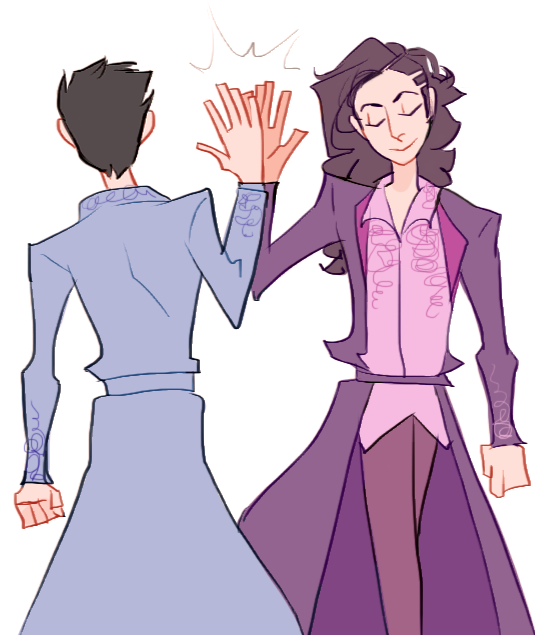
Romeo and Benvolio could get a “bachelor pad” right next to Juliet and Mercutio’s house. Every night, Romeo and Mercutio high five as they hop the fence to go bang their one true love.
The second half of the play is just all of them trying to keep up the charade and being “THIS CLOSE” to getting caught all the time. But everything ends nicely because true love conquers all.
Everybody wins. Nobody dies.
THE SHAKESPERE AU I NEVER KNEW I NEEDED
DUDE DID YOU JUST FIX ONE OF THE MOST ICONIC PLAYS EVER CREATED?!
ONCE AGAIN EVERYTHING IS SOLVED BY THE QUEER LENS.
all right. so. this is a Harry Potter AU, in rambly and abbreviated form.
this is a version of events where, on the morning of November 1st, 1981, the police are called to a house in Surrey.
when they arrive, a large man with a red face and a moustache is waiting for them, brandishing a baby.
to be more accurate: he is brandishing a basket. the basket contains a baby.
he tells the police that his wife found the basket on their doorstep that morning. “Gave her the shock of her life,” he says, with a chuckle that does not seem the least bit sincere.
the police officers have a lot of questions about this, but the man does not have any useful answers. his wife, he tells them, is not in any shape to be interviewed. “she’s been poorly,” he says, “and we’ve got a baby of our own to worry about, keeping us up at all hours.”
the baby in the basket seems to be about a year old. he is cheerful, seems healthy aside from a cut on his forehead, with a crooked sticking plaster on it. he has startlingly green eyes.
there is no identifying information in the basket, except for a torn scrap of paper with ‘his name is Harry’ on it in a delicate hand.
there is nothing else to be done, it seems. the officers take baby Harry, and leave.
one of them comes back a few days later for a follow-up interview with the woman who found the baby. she seems a little fragile, and her own baby, in the next room, keeps up a constant shrieking tantrum the whole time the officer is there. “I’m sorry,” the woman says, with a brittle smile. “this has all been a bit much. I recently lost my sister, you see.”
so: that’s all for the Dursleys.
baby Harry, on the bright side, is a sweet-tempered infant in good health, with no knows legal claimants to custody.
he is adopted very quickly, by a family who has had a nursery standing empty for some time, and for whom he is the fulfillment of a long-awaited dream.
so, rather than a cupboard under the stairs, Harry has a cozy bedroom with a window seat, a heap of stuffed animals, a rocking chair where his mother sings him lullabies that are really her favorite poems set to made-up tunes.
he has a father who already owned a whole shelf of cookbooks the day they brought him home, and promptly starts filling a second shelf with South Asian cookbooks because he has read that children of color adopted by white parents should be able to maintain links to their culture of origin.
he is not, from this point, Harry Potter. He is Harry Jones or McIntyre or Lee; more importantly, he is happy and loved.
when Harry is two or three, something terrible happens that he knows nothing about. it does not make the Muggle papers, but it does, to Dumbledore’s dismay, make the Daily Prophet.
there is a great deal of upset, and a number of people want to know why no one noticed, before now, that the Boy Who Lived has gone missing.
the question of why no one noticed the murder of his aunt and uncle is quite secondary.
Dumbledore has no good answers, and no luck at all in finding any.
the problem of public attention, at least, solves itself when Sirius Black escapes from Azkaban, and captures the Daily Prophet’s front page for a good long while.
it would be nice to think that whichever Death Eater tracked down and murdered Vernon and Petunia did not bother to murder Dudley.
i am not sure I can offer you that comfort, sadly.
they left without what they came for, at least: even if they had been able to find the police officers (they weren’t, as Vernon had long since forgotten their names), or the social worker who handled Harry’s case (who had changed jobs six months ago), they would never have been able to navigate Muggle bureaucracy well enough to find Harry himself.
some people are more determined, though, and have better motivations.
when Harry is six, a dog follows him home from school.
in fact, the dog had also followed him to school that morning, waited patiently by the gate to the playground until recess, allowed innumerable children to pet him and tug his ears, and consented to play fetch only when it was Harry throwing the ball.
his parents are surprised but not dismayed when their son comes home with an extremely large and exceptionally well-behaved black dog, and begs to keep him.
“he looks just like that stuffed toy you loved when you were a baby,” his mother says. “remember?”
the dog is christened Padfoot, after the toy, which name had been his parent’s best guess at what baby Harry had been calling it.
luckily, they were good guessers.
Padfoot is a very good dog. he does not chew things that ought not be chewed, he is wonderfully protective of Harry, he sheds much less than you would expect.
he does, however, have a strange knack for removing every dog collar Harry’s parents buy for him within twenty-four hours.
eventually, Harry goes out to the shed, locates a length of curb chain as thick as his thumb and a small carabiner, and attaches Padfoot’s tags and license to it.
It ought to slip off right away, as it is far too loose to be called a collar, but to everyone but Harry’s surprise Padfoot tolerates it with perfect equanimity.
it’s not like he ever actually needs a leash, anyway: it was already clear that taking Padfoot for a walk meant that both parties agreed to the polite fiction that the leash meant anything at all.
he is an extremely smart dog. it’s a little uncanny.
Harry’s parents never know that their dog’s original plan had been to kidnap their son, but that he had changed his mind after seeing their cheerful, bright house, the shelves of cookbooks and the wall of strangely frozen family photos, the rocking chair where Harry’s mother sings ‘come away, o human child’ to him at bedtime.
Padfoot has lived with much worse. for Harry’s sake, he would again, but he’s glad he doesn’t have to.
when Harry is eight, a number of extraordinary things happen:
first of all, Harry and his dad decide to repaint Harry’s room.
(this is not one of the extraordinary things.)
that night, Harry sleeps on the downstairs sofa, as his room still smells of wet paint a bit too much.
(neither is this.)
he has a harder time falling asleep than usual: the sofa is a little too soft, and he is used to Padfoot sleeping on top of his feet, but there isn’t enough room so Padfoot is sleeping on the floor beside him instead.
this is why Harry is still just barely awake when the extraordinary thing happens.
(here it is:)
Harry hears a strange sound, a sort of fluttering, scratching noise, and cracks open one eye. the living room is not quite dark, so he sees Padfoot get up and go silently over to the window.
Padfoot noses the curtain aside.
there is an owl outside the window, hooting urgently.
Harry is now wide awake, but keeping perfectly still in case this turns out to be a dream after all. he doesn’t want to wake up in the middle of whatever this is.
he watches as his dog opens the window.
he wonders how he manages it with paws.
the owl flies inside, swooping over the sofa towards the kitchen. Padfoot follows it.
very carefully, as quietly as he can, Harry levers himself up enough to peer over the back of the sofa. he can see into the kitchen, where the owl has just landed on the table.
Padfoot and the owl regard each other silently for a moment. then Padfoot lets out a doggy huff– a sort of ‘well, all right’ sound– and turns into a human being.
this is too astonishing for Harry to even gasp at.
the owl hoots softly at Padfoot, who is now a human person. “all right, all right,” grumbles Padfoot, formerly Harry’s dog, now a man with tangled black hair and ragged clothes. the man, who was until very recently a dog, takes a folded piece of paper from the owl. the owl hoots again, impatiently.
“give me a moment, all right?” says the man who is also Harry’s dog, Padfoot. he opens the fridge and takes out the other half of the sandwich Harry’s dad had for lunch. he taps it with a wooden stick and quite suddenly there are two identical sandwiches, one of which the man-who-is-Padfoot puts back.
the second one he eats. just sits down at Harry’s kitchen table like he wasn’t a dog a minute ago, pulls up a chair, and eats the sandwich, while unfolding and reading the piece of paper that the owl gave him.
he gives some bits of sandwich to the owl, too.
after he’s eaten, he takes a biro out of the jam jar in the middle of the table and writes something on the back of the paper, folds it back up, and gives it to the owl.
the owl takes the paper in its talons, and swoops back out of the kitchen, over the sofa, and through the window.
Harry watches it go, still astonished.
then he turns back to the kitchen, where Padfoot, who is still a human and not at all a dog, is staring at him. Harry stares back.
“damn,” says the man. “I suppose you have some questions.”
“are you magic?” asks Harry.
“yes,” says the man. he is wearing Padfoot’s tags and license on a necklace.
“are you a werewolf?” asks Harry.
“what? no,” says the man. “why would I– that’s not how werewolves work.”
“well, no,” says Harry, who has now had a second to think about it and feels a little foolish. “I suppose you’d have to be, like, a reverse werewolf, right? because you’re a dog all month and now you’re a man.”
“I’m not a reverse werewolf either,” says the man. “I’m your godfather.”
“My fairy godfather?” Harry asks, because his mother read him a lot of Brothers Grimm.
“not– in that sense, no,” says the man. “Just your regular godfather.”
“my regular godfather, who is magic,” says Harry.
“yes,” says Padfoot, who has lived in Harry’s house for two years now, and read most of the books on its shelves in the middle of the night, including the ones with titles like The Adoptive Parent’s Toolkit and My Family, My Journey.
he says, “your birth dad was my best friend.”
“was he magic too?” asks Harry.
“yes,” says Padfoot. “and so was your mum. and so are you.”
“what?” says Harry, who had not been expecting this turn of events in the least.
“you’re a wizard, Harry,” says Padfoot. “and so am I.”
edited to add: links to part two and part three. more as they get written!
What Amazon will probably say to justify this later: “It’s so we can tell if one of our staff is stealing”
What the article says it’s for: “It vibrates or shocks employees if they sort the packaging wrong”
What Amazon’s ulterior motive probably is: “We can track the pace of their work and if they’re taking a few seconds too long or using their hands to wipe their sweaty brows, we bring it up at a performance review and will fire them for it. But remember that if you whine about this or demand better conditions/wages, we’ll just replace you with robots, so keep working you mindless and invasively-monitored drones“





 Death By Catchphrase