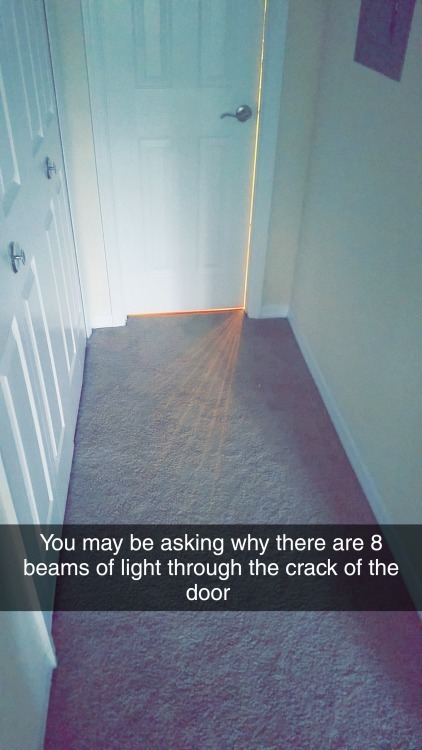
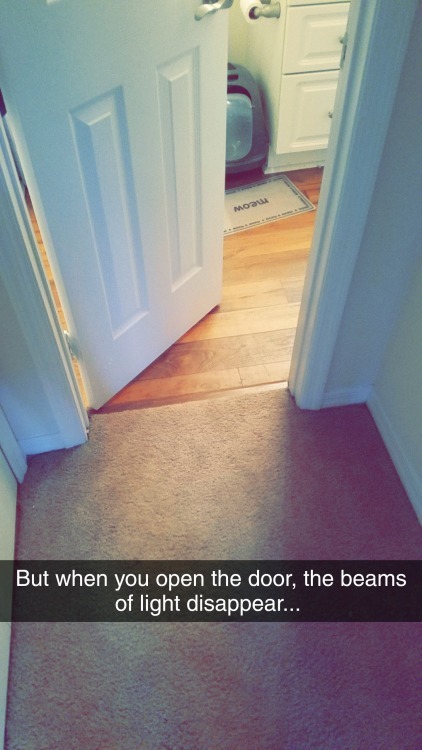
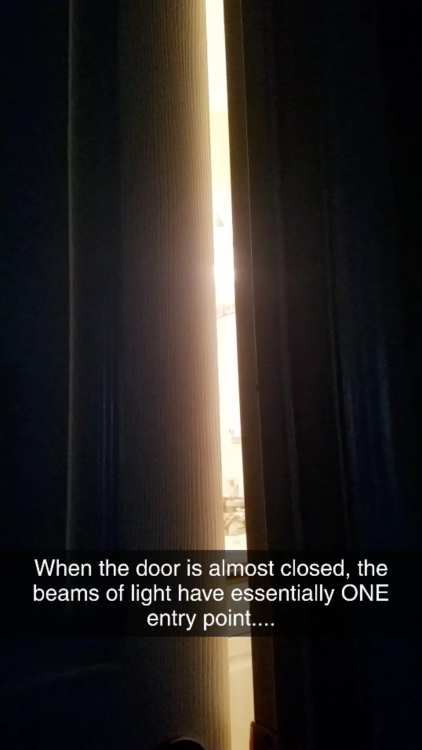
I was gonna do my laundry but when I turned the corner and saw this on the ground I stopped what I was doing and decided to make a snapchat story of science (I’m @thescalex on snapchat, if you want my username)
*cue Charlie Brown soundtrack of kids cheering*
There’s your science for the day. Go try it out for yourself!
It’s Thanksgiving time…which means you’re probably thinking about food…
Ever wonder what the astronauts living and working on the International Space Station eat during their time 250 miles above the Earth? There’s no microwave, but they get by using other methods.
Here are some fun facts about astronaut food…
Astronauts are assigned their own set of silverware to use during their mission (they can keep it afterward too). Without a dishwasher in orbit, they use special wipes to sterilize their set between uses, but it’s still better for everyone if they keep track of and use their own! So many sets of silverware were ordered during the space shuttle program that crews on the space station today still use silverware engraved with the word “shuttle” on them! So #retro.
You probably know that astronauts use tortillas instead of bread to avoid crumbs floating everywhere. Rodolfo Neri Vela, a payload specialist from Mexico, who flew on the space shuttle in 1985, introduced tortillas to the space food system. Back then, we would buy fresh tortillas the day before launch to send on the 8-10 day space shuttle missions.
We then learned how to reduce the water activity when formulating tortillas, which coupled with the reduction of oxygen during packaging would prevent the growth of mold and enable them to last for longer shuttle missions. Now, we get tortillas from the military. In August 2017, acting NASA Administrator Robert Lightfoot ate a meal that included tortillas from 2015!
Our food menu is mostly all made from scratch so it can meet the requirements of the nutrition team and ensure astronauts eat enough fruits and vegetables. The space station is stocked with a standard menu that includes a mix of the more than 200 food and drink options available. This ensures lots of variety for the station crews but not too many of each individual item.
The food is packaged into bulk overwrap bags, referred to as BOBs, which are packed into cargo transfer bags for delivery to the space station. Each astronaut also gets to bring nine personalized BOBs for a mission, each containing up to 60 food and drink options so they can include more of their favorites – or choose to send a few specific items for everyone to share on a particular holiday like Thanksgiving. As a result, the crew members often share and swap their food to get more variety. Astronauts also can include any food available at the grocery store as long as it has an 18-month shelf life at room temperature and meets the microbiological requirements.
Fresh fruit and vegetables are a special treat for astronauts, so nearly every cargo resupply mission includes fresh fruit and veggies – and sometimes ice cream!
The Dragon spacecraft has freezers to bring science samples back to Earth. If there is space available on its way to orbit, the ground crew may fill the freezer with small cups of ice cream or ice cream bars.
Some food arrives freeze-dried, and the astronauts rehydrate it by inserting a specific amount of hot or ambient water from a special machine.
Other food comes ready to eat but needs to be reheated, which crew members do on a hot-plate like device. We recently also sent an oven style food warmer to station for the crew to use. And of course, some food like peanuts just get packaged for delivery and are ready to eat as soon as the package is opened!
Our nutritional biochemists have discovered that astronauts who eat more fish in space lost less bone, which is one of the essential problems for astronauts to overcome during extended stays in space. In the limited area aboard the space shuttle, not all crew members loved it when their coworkers ate the (aromatic) fish dishes, but now that the space station is about the size of a six-bedroom house, that’s not really a problem.
Astronauts on station have had the opportunity to grow (and eat!) a modest amount of fresh vegetables since the first lettuce harvest in August 2015, with new crops growing now and more coming soon. Crew members have been experimenting using the Veggie growth chamber, and soon plant research will also occur in the new Advanced Plant Habitat, which is nearly self-sufficient and able to control every aspect of the plant environment!
Growing food in space will be an important component of future deep space missions, and our nutritionists are working with these experiments to ensure they also are nutritious and safe for the crew to eat.
Thanksgiving in Space
The crew on the space station will enjoy Thanksgiving together. Here’s a look at their holiday menu:
Turkey
Mashed Potatoes
Cornbread Stuffing
Candied Yams
Cran-Apple Dessert
Learn more about growing food on the space station HERE.
Make sure to follow us on Tumblr for your regular dose of space: http://nasa.tumblr.com.
Astronaut Food has come a long way since when I was a kid!
Historian Thomas Cahill, author of The Gifts of the Jews
(Knopf, 1999) claimed that the Jews invented the very concept of
history. They were the first, he said, to perceive time not as an
endless circle of life, death and rebirth, but as the flight of an
arrow, on a linear path to somewhere from somewhere.
However, what if time is not one arrow, but a volley
of arrows? What if there are other timelines, other histories, other
Jews? Would they still have a covenant with the one God? What would have
become of their triumphs? Their defeats? Their suffering and their
successes?
Award-winning author/editors Andrea D. Lobel and Mark Shainblum propose to answer this question in Other Covenants, the first-ever anthology of Jewish alternate history, to be published by ChiZine Publications in Fall 2019!
SUBMISSION GUIDELINES
Submission window: August 28, 2017 at 12:01 AM Eastern Time to Sunday, Feb. 4, 2018, at 11:59 PM Eastern Time.
Open to submissions by authors of all backgrounds, from anywhere in the world.
Stories must be in the alternate history genre and must be clearly relevant to the theme of the anthology.
Length: 500–15,000 words. There are
relatively few spots for stories at the high end, so please query first
if you think your story will go long.
Preference will be given to stories
previously unpublished in English, however, we will consider previously
published stories on a case-by-case basis.
NEW: Also open to poetry submissions. Original
poems on theme. No more than 2 pages (8.5 x 11) in length. (Maximum word
count set arbitrarily to 2,000 words as system won’t allow max lines or
pages.) No need to double-space.
Submissions may be made in English or French. Author is responsible for translations into English after acceptance.
English-language translations of
stories from other languages (published or unpublished) are welcome, but
we can only accept submissions in English or French.
Multiple submissions welcome; up to two stories maximum per author, sent under separate cover.
We prefer no simultaneous submissions, please (we promise to respond promptly).
Initial responses (rejections, holds,
and rewrite requests) within 30 days of submission; final responses no
later than 30 days after the deadline.
Payment is 8 cents per word in Canadian funds. (SFWA qualifying after exchange to US funds).
File formats accepted: .docx, .doc, or .rtf.
Formatting: indented paragraphs;
italics in italics (not underlined); Canadian spelling; use # (or other
unambiguous symbol) to indicate scene breaks; no headers, footers, or
pagination; no outlandish formatting, please; full contact info (name,
street address, email, phone number) and word count on the first page.
That said, don’t fret too much about formatting; good fiction is what’s
most important. (Correct spelling also counts.)
Please include a cover letter with a brief author bio, title of story, and full contact info, including street address.
Please do not summarize or describe the story in the cover letter.
To be published by ChiZine Publications in Fall 2019.
Rights: First World Rights, including
audio and translation rights. (NOTE: CZP has a foreign rights agent who
will be presenting the anthology in foreign markets.)
NOTE ON PSEUDONYMS: we will only
publish one story per author, even if you write under several names;
please use your real name on all correspondence and indicate your
pseudonym in the cover letter and on the byline of the story itself.
NOTE ON SUBJECT MATTER: Any book
dealing with the Jewish people, Jewish history and Israel will, by
definition, be controversial. We welcome controversy and politics, but
don’t forget that this is a fiction anthology. Telling good stories
takes first, second and third place. Submissions that grind axes loud
enough to drown out the story are unlikely to be accepted.
Questions or queries: othercovenants@gmail.com. Please don’t submit stories via email, as noted above.
A WORD ABOUT THE ALTERNATE HISTORY GENRE
Other Covenants is open to
authors of every background, and for those of you who may not be
familiar with alternate history, here’s a quick thumbnail sketch of the
genre.
A popular sub-genre of speculative fiction, alternative history weaves
fictional narratives into the “what-if”s of the past, and explores the
infinite number of historical roads not taken in the past, present or
future.
The Collins English Dictionary
defines alternative history as “a genre of fiction in which the author
speculates on how the course of history might have been altered if a
particular historical event had had a different outcome.” According to
Steven H. Silver, an American science fiction editor, alternate history
requires three things:
1. A point of divergence from the history of our world prior to the time at which the author is writing
2. A change that would alter history as it is known
3. An examination of the ramifications of that change
Although alternate history is related to
counterfactual history, it is distinct from it. The latter term is used
by historians to refer to the academic, non-literary, question “what
could have happened if …”.
Now please don’t take the above as
prescriptive or proscriptive. We understand that boundaries are vague,
definitions are fuzzy, and the distinction between an alternate history
and a counterfactual may be entirely in the eye of the beholder. But
whatever voice you write in, please keep in mind that first and foremost
we are looking for stories about characters.
Also, though alternate history originated as a sub-genre of science fiction and fantasy and may incorporate tropes like the many-worlds theory, parallel universes, time travel, mysticism and magic, these are not
requirements. Use them if you want to, don’t use them if you don’t. The
only speculative element required is the break from history as we know
it, and the effect of that break on the Jewish people.
THE KIND OF THEMES WE MIGHT EXPLORE:
Please don’t take these as prescriptive
or proscriptive either, the whole canvas of Jewish history is open to
you—Biblical, historical and mythological:
What if • the Holocaust had never happened?
What if • Joseph’s brothers had not sold him into slavery in Egypt?
What if • The State of Israel had been established in Uganda? Or Germany?
What if • Jesus’ followers had not broken with Judaism?
What if • The Jews had proselytized their faith door-to-door for a thousand years?
What if • The Romans had not destroyed Jerusalem and the Second Temple?
What if • Judaism became the dominant Western religion, but was
riven by conflicts between the Temple priesthood and reformist rabbis
who put the Torah and prayer before Temple ritual and sacrifice?
What if • The Spanish Inquisition had never occurred?
What if • Napoleon had not smashed down Europe’s ghetto walls?
What if • The Protocols of the Elders of Zion were reality … in some other universe?
ABOUT THE EDITORS
Andrea D. Lobel has been a writer and editor for over a decade, winning two awards for her work.
An ordained rabbi and university
lecturer, she holds an M.A. in Religious Studies (McGill University),
and a Ph.D. in Religion (Concordia University), specializing in the
history of religion and science, astronomy and religion, celestial
mythologies, calendars, magic, and religious authority in Judaism, as
well as in the Hebrew Bible and its ancient Near Eastern context.
Her book, Under a Censored Sky:
Astronomy and Rabbinic Authority in the Talmud Bavli and Related
Literature, is forthcoming from Brill Publishers in 2018–19.
Mark Shainblum was born
and raised in Montreal, where he and illustrator Gabriel Morrissette
co-created the acclaimed comics series Northguard and Angloman with
Gabriel Morrissette. Northguard has recently been revived by
Chapterhouse Comics in Toronto.
In addition to writing comics, Mark has published science fiction in various magazine and anthology markets including On Spec and Island Dreams: Montreal Writers of the Fantastic. As an editor, he co-edited Arrowdreams: An Anthology of Alternate Canadas with John Dupuis in 1998 and Superhero Universe: Tesseracts Nineteen in 2016 with Claude Lalumière.
Mark shared an Aurora Award with John Dupuis in 1999 for Arrowdreams, and in 2016 he was inducted into the Joe Shuster Awards Canadian Comic Book Creator Hall of Fame.
Mark and Andrea live in Ottawa with their daughter.
HERE. FOR. THIS. Mark’s anthology Arrow Dreams is one of my fave alt history anthologies and Angloman is a gem of Anglo Montreal history.







 Death By Catchphrase